Read here
Read Here
6 stories available. Expand any title to read the full story.
The Day of the Toad
Young World, The Hindu, 1995
The Day of the Toad
Young World, The Hindu, 1995
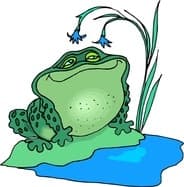
Croaky was a big, fat toad who lived in a large field, thick with jungle grass. I am sure you can guess why he was called Croaky. Yes, of course – it was because of the hoarse croaks that came from deep within his throat. Croaky looked like any other toad. His bulbous eyes bulged from his head, and his rough skin was covered with warts. He had no teeth, and so, when he parted his thin, wide lips to smile, he looked very ugly indeed. But Croaky did not seem to mind his ugliness at all. He did not long to be beautiful, nor did he try to beautify himself. This was because Croaky believed in fairy tales, or rather, in one particular fairy tale, which he firmly believed, was one day going to change his life forever. And he had come to hear about it purely by chance.
He had been crouching lazily near a slushy little pond that lay in the middle of his field, his eyes half shut. He had taken no notice whatsoever of the lovely, long-necked swan who had brought her seven babies to the pond for a swim. The cygnets were rather unattractive, and as they splashed about noisily in the water, Croaky had heard one of them ask his mother shrilly, “Mama, when will we become as beautiful as you are?”
“Be patient, dears,” Mother Swan had replied lovingly in a soft voice. “Someday, you will all be beautiful swans.”
“Oh good!” the precocious little cygnet replied. “I do so want to be beautiful! I should hate to go through life looking being as ugly as old Croaky, for instance.”
“Hush!” said mother swan, silencing him instantly. “You really must not speak like that, dear. It is terribly ill-mannered, and vain. And who knows? Perhaps old Croaky will turn into a prince one day…”
“Turn into a prince? Whatever do you mean?” asked the cygnet curiously.
Mother swan shrugged, and laughed. “It’s just a fairy-tale,” she said carelessly, “but an interesting one. If you are all good, I shall tell it to you when we are drying off after our swim.”
And that was how Croaky came to hear the story of the frog prince.
As he had crouched in the thick grass, he had heard mother swan narrate the story of how a beautiful princess had once lost her little golden ball in a pond while she was playing. And the ball had been seized by a toad – one exactly like Croaky himself. But did the toad return the ball to the princess? No! Croaky had heard mother swan say that the toad had made the princess promise that she would take him to her palace if he returned her precious ball to her. And, so, the toad had gone to live in the fair maiden’s palace. And then, wonder of wonders! Croaky heard that there, the beautiful princess had kissed the toad. Yes! Then, magically, his hideous scaly skin had fallen away, and he had turned into a handsome, dazzling prince.
It was the most wonderful story that Croaky had ever heard, and long after mother swan had left with her family, her words rang in his ears. As he sat there silently in the tall grass, and mulled over the tale in his mind, he began to feel excited. Croaky was sure it had been a true story. And it had happened to a common, ordinary toad like him! Why, the more he thought about it, the more Croaky realized that it could happen to him too. He, Croaky the toad, could well turn into a handsome prince one day. In a flash of inspiration, Croaky decided that when he became a prince, he would call himself Prince Dazzle.
Now, once he had heard this fairy tale, Croaky could think of nothing else.
He spent his days dreaming of how he would turn into a prince. But he soon realized that hidden away among the tall, overgrown grass, there was no way that a princess would ever find him. So, Croaky decided that he would take up a vantage position near the pond.
He jumped on to a rock, and sat upon it. His bulging eyes darted all round the field, as he surveyed the landscape for the beautiful princess who he was sure, would come to find him. He perched patiently on the rock in this manner for many days, in sun and rain, and waited and waited.
An old turtle, who also lived near the pond, watched Croaky curiously for a few days. Finally, when he could contain his curiosity no more, he ambled up slowly to Croaky. “Croaky,” he said in a puzzled tone, “pray tell me, what on earth are you doing, perched on that rock for days on end?”
Croaky replied, “I’m waiting for a princess to find me. She will take me away to her palace, and there, she will kiss me, and I will turn into a prince! And you know what? I’m going to call myself Prince Dazzle.” A note of great pride and triumph crept into his voice as he spoke the last few words with a flourish, and looked down patronizingly at the turtle.
The old turtle was silent for a moment, and then a slow smile spread across his wrinkled, weather-beaten face.
“My dear Croaky,” he said, chuckling softly. “How can you possibly believe such nonsense? Such things don’t happen in real life — they happen only in fairy tales! You are never going to become a dazzling prince…”
“Oh, pooh,” Croaky butted in rudely, looking down scornfully at the turtle from his lofty perch. “You are only saying that because you are jealous. Why, I’m sure you’d secretly like a princess to kiss you too, and turn you into a dazzling prince.”
“Not at all,” said the turtle firmly. “I’m quite sure that I like being myself. And as for you, you’d better get off that rock quickly. If you are not careful, you will be seized by schoolchildren looking for toads to dissect, and then, you’ll be cut into little pieces in their school laboratories…”
Croaky sniffed contemptuously and murmured under his breath. “Not me! I’m going to become Prince Dazzle.” The turtle continued, “Once they caught me also, and they took me to their school laboratory to display me as a specimen. A dreadful experience it was too.” He shuddered violently at the memory. “I did not put my head out of my shell for two whole days while I was there. The laboratory was full of frogs and toads like you, and most of them had been cut up into little pieces! Good grief! What a relief it was to me when they threw me back into our field. You’d better be careful, Croaky,” he warned.
But Croaky, ambitious toad that he was, paid no attention to the wise turtle’s words. He continued to sit hopefully on the rock every day, and then, unexpectedly, one day, a small girl came to the pond. She was riding a big, red bicycle, and was wearing a pleated grey school pinafore with a white blouse. She did not look like a princess at all, but Croaky, who had never seen a princess before, did not know that. He watched excitedly, with bated breath as she took off her shoes and socks and waded carefully into the pond.
“Croak! Croak!” Croaky said loudly, in what he believed were warm, welcoming tones. “Here I am! I’ve been waiting for you for so long!” He trembled in excitement. His big dream was going to be realized at last.
The little schoolgirl moved forward nimbly, and then for Croaky, his dream started to turn into a nightmare. For the little girl, with surprising speed, whipped out a little black net that she had hidden in the folds of her pinafore. She threw it over Croaky, sitting hopefully on his rock. As the strong, black web fell over him, it held him tight within its folds. But poor Croaky did not move a muscle or struggle, for he was too stunned by this turn of events to react.
The schoolgirl quickly snatched up the net, and then, in a trice, had thrust Croaky into a little cardboard box which had a few holes bored in its lid. She tied up the box securely with string in a flash, and hung it on the handlebars of her bicycle. As she tied her shoelaces, she beamed with pleasure. “What a nice, fat toad I have got today for my dissection,” she murmured to herself. “Today is my lucky day!”
But as Croaky sat all squashed up in the little cardboard box, he began to realize what a pitiable state he was in. He shivered as he recalled the wise old turtle’s words, and the awful truth about his situation finally sank in. The person who had found him was definitely not a princess, and he was never going to be a prince either. The fate that awaited him was truly horrible.
Then, with a burst of his old spirit, Croaky decided that he could not let something so dreadful happen to him without at least trying to do something about it. Summoning up all the strength in his body, he began to leap up and down furiously in the cardboard box, using his stout, powerful legs. The flimsy cardboard box began to rock perilously, and the little girl, who was steering her bicycle, took her hands off the handlebars for a moment to try and still its motion. But alas! A moment was all that was needed for the girl to lose control of the bicycle, which zigzagged crazily across the road, and then fell down, with its wheels spinning madly. The cardboard box hit the ground with a thud, and burst open, and Croaky was free! With a mighty leap, he escaped from the box, and by the time the little girl got shakily to her feet, dusted herself down, and started looking around for her toad, he was many, many jumps away. He was soon back in his own field, hidden securely by the tall jungle grass. How happy he was to return to his old home, even though he was still the same ugly toad.
Croaky soon pushed his dream of turning into Prince Dazzle to the back of his mind, and he tried not to think of it ever. But sometimes, the thought still springs to his mind unbidden, once in a way, as he hops around the field where he still lives. And he just can’t help wondering — why do fairytales never come true?
Copyright Santhini Govindan. Please do not reproduce without permission.
Bubbles For Grandpa
YOUNG WORLD, 2017
Bubbles For Grandpa
YOUNG WORLD, 2017
YOUNG WORLD (The Hindu, Chennai) BUBBLES FOR GRANDPA NOVEMBER 03, 2017 Anisha and her friends were excitedly organising a surprise party for Anisha's grandfather's 85th birthday. "I've a great idea," Anisha said. "I'll get a huge bunch of 85, colourful helium filled balloons for grandpa to release into the air. It'll make for a great photograph too." "That's a terrible idea," Meena burst out agitatedly."Why?" Anisha asked crossly. "Everyone likes festive balloons!" "But helium balloons are dangerous for animals and birds!" Meena shouted angrily. Meena was an intrepid animal lover who volunteered at the local animal shelter. As her bewildered friends stared at her, Meena sighed. "I'd better explain that clearly," she said. "A balloon floating into the sky eventually bursts, or loses air, and falls to the ground.
If it's spotted by a hungry bird or animal, the creature swallows it, thinking that it's a tasty scrap. But the balloon can block the animal's or bird's intestinal tract, leading to starvation and a slow, painful death. Balloon strings are equally dangerous. A bird tangled up in a balloon string, can't free itself, and eventually dies. Whales, sea birds, and turtles have choked to death after swallowing balloons. Latex balloons take years to disintegrate." Meena showed her friends a photograph on her cellphone, of a seagull that had died on a beach after getting tangled in balloon strings. Everyone stared at the photograph silently. "We didn't know this, Meena," said Anisha apologetically. "But now that we do, we won't use any balloons." "Thank you!" said Meena fervently.
In the days that followed, Anisha scouted for ideas for party decorations without balloons. Surprise! Finally, grandpa's birthday arrived. When grandpa strolled into the garden, he was surprised to see the large, colourful, tissue paper pompoms Anisha's friends had made, and hung in bunches around the garden. They swayed and rustled as the wind blew. "Did you make these?" grandpa asked Anisha's friends admiringly. "They're superb!" "We didn't use any balloons," Anisha explained. "Meena told us that they can harm birds and animals." "Excellent!" said grandpa grinning. "I hate it when balloons burst with a la loud POP, and terrify my dog Scotty." After grandpa cut his birthday cake, Anisha gave every guest a small bottle filled with a greenish liquid. A little stick was taped to each bottle.
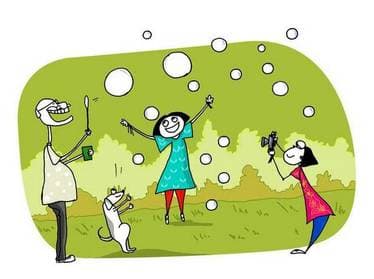
"What's this?" grandpa asked, examining the bent wire attached to the stick. "It's a bubble wand," Anisha giggled. "Try to blow soap bubbles with it!" Grandpa dipped his bubble wand into the soap solution, pursed his lips, and blew gently. A little round bubble immediately appeared. As grandpa blew harder, the bubble grew. Finally, the shimmering, rainbow coloured bubble slid out from grandpa's bubble wand, and floated into the air. Scotty chased it, barking excitedly. But before he could catch it, the bubble burst! As Scotty looked perplexed, grandpa roared with laughter. Soon, everyone was blowing bubbles. Anisha photographed grandpa, smiling merrily, surrounded by a sea of bubbles. "This is fun!" said grandpa. "Scotty and I would like to do this again..."
Copyright Santhini Govindan. Please do not reproduce without permission.
Quiet Flows The River
Young World, 2017
Quiet Flows The River
Young World, 2017
The story below appeared in the 'Young World' of 'The Hindu' newspaper on November 17, 2017 QUIET FLOWS THE RIVER By 2011, the Kuttemperoor River was dead. That was when the villagers of Budhanoor woke up. In a matter of years, they set to work and revived their beloved river.The Kuttemperoor River had never been a big river. A younger sister of the mighty Pampa and Achankovil in the Alappuzha district of Kerala, she was only about 12 km long, and 100 metres wide. But the Kuttemperoor was a happy river. She stretched through the little village of Budhanoor in Alapuzha, and the villagers loved their beautiful river. The clear, greenish-blue river gave them drinking water, and provided farmers with enough water to irrigate about 25,000 acres of paddy fields.
The villagers fished, played, and swam in the river, and local traders transported their goods on it in small boats. Every day, the river heard the excited shrieks of children as they leapt into her clear, cool water. She watched birds dive into her swirling currents to catch fish. She smiled as she listened to the chatter of women washing clothes on its banks. Her waters washed gently over the huge elephants from nearby temples that came for a bath in the river. Buffaloes waded into the river, and she let them wallow happily in her rippling water. The generous river was home to all kinds of fish, turtles, water snakes, and even crocodiles. Every year, when the monsoons lashed Kerala, the Pampa and Achankovil overflowed.
The Kuttemperoor generously absorbed the extra water from her sisters, so that the settlements clinging tenaciously to their banks didn't get flooded. But as the years passed, things changed for the small river, and for the little town of Buddhanoor. Industrialisation brought toxic waste to the area, and it was dumped into the Kuttemperoor. The river was upset by this. She coughed and gasped for breath. She tried desperately to wash away all the dangerous and noxious chemicals that were tossed so callously into her body. But she couldn't, and to her dismay, piles of plastic bags, bottles and tin cans were added to the garbage that were thrown into her. The desperate river struggled to push all the trash deep down onto her bed so that she could breathe, but the mountain of garbage was just too much for her to cope with.
By 2005, the Kuttemperoor had shrunk to a width of only 10 metres. Her once swiftly flowing water, moved slowly, and was smelly, dark, and murky. Weeds grew in tangled masses on her banks, and the aquatic creatures that had played in her waters were rapidly dying. The Kuttemperoor was choking to death. Death throes In 2011, a boat got stuck in the water of the river that had, by this time, turned to a gooey sludge. How the river wept as firemen dragged the boat out. "Help me! Save me!" the river cried out from her heart. But no one heeded her cries, and in a few months, the heart broken river, which had been so badly treated, just sunk sadly into the ground in despair, and perished. Budhanoor no longer had a river. After the Kuttemperoor vanished, the villagers realised that the river had been their lifeline.
She had provided them with water to drink, plenty of fish, water for their paddy fields, and a delightful place to play, and enjoy themselves. But they had failed their gracious and generous river. They had not looked after her health and her needs. As they sorely missed, and remembered their lost river, the villagers were filled with sorrow and deep remorse. In 2013, the members of the Budhanoor village panchayat decided that they would try to bring their beloved river back to life. But this was easier said than done. It took four years for a viable plan to be made, but by January 2017, the project to revive the Kuttemperoor was implemented under the government's Mahatma Gandhi National Rural Employment Guarantee (MGNREGA) scheme.
Seven hundred men and women from Buddhanoor volunteered to work to clean up the river, which was now nothing more than a slushy swamp. Revival First, the villagers had to wade into the dirty water and cut out the dense growth of water weeds that hid the river's face. Next, they had to remove all the plastic waste that had choked away its life. And finally, the villagers had to clean the thick layer of trash that was clustered and embedded at the bottom of the river bed. All this was no easy task. Mosquitoes swarmed the villagers, biting them as they worked. Many fell ill, but they were not deterred from their task. They were on a mission, and were determined that they would do whatever it took to bring their beloved river back to life.
They slaved away clearing away the sewage, plastic waste and clay sediments that had destroyed the Kuttemperoor. After 45 days of hard work, clearing tonnes of garbage, the river, which had been dead for years, was slowly resuscitated. As she awoke, water started slowly flowing in the river bed. The triumphant and delighted villagers pressed on even more enthusiastically. By the 70th day of their work, the Kuttemperoor had started flowing normally again. Buddhanoor's beloved river was back! The villagers welcomed her joyfully. The river was so delighted to return to her precious land that she gave the wells in the neighbourhood the gift of increased water. She invited fish and other aquatic creatures to return to her cool water.
The people of Budhanoor village still do not use the water of their river for cooking and drinking, but they are confident that they will be able to do so in the near future. They put their heart and soul into reviving their precious river, and now, they take great care of her health. They are careful not to pollute her, because they are determined that their happy river will live forever...
Copyright Santhini Govindan. Please do not reproduce without permission.
Bath With Three Buckets Of Water
A Quick Read, 2000
Bath With Three Buckets Of Water
A Quick Read, 2000

A BATH WITH THREE BUCKETS OF WATER During weekends when she had no school, eleven year old Rohini accompanied her mother Gowriamma to work. Gowriamma worked as a maid in a large bungalow not too far from the slum where she lived. She had to sweep and mop floors, and wash mountains of dirty clothes and dishes day in and day out. She was relieved on those days when Rohini was around to give her a helping hand. Though Rohini had to work hard alongside her mother too, she really enjoyed going to the 'bungalow', because a friendly little girl named Anuja, who was about her own age, lived there. On Saturdays, after Rohini had whizzed through her share of the chores, she would hurry upstairs to meet Anuja. Anuja had a room of her own. It made Rohini's eyes light up; for it was the prettiest room she had ever seen.
She marvelled how everything in it always looked clean and bright. Anuja had cupboards heaped with expensive books and toys that Rohini gazed at with wonder and delight. She also had a dressing table, with drawers full of trinkets and hair clips. Sometimes, when Anuja came across a bauble that she was tired of, she would press it into Rohini's palm with a smile. Anuja's room also had its own luxurious attached bathroom, and Rohini found this fascinating. Its blue tiled walls were sparkling, and whenever she had to clean the bathroom, Rohini liked to lay her cheeks against them to feel their icy coolness. The tiled floor was slippery too, when wet, and Rohini giggled at the way her feet always skidded on their smooth, shiny surface.
The shelves in the bathroom were filled with shampoos and soaps, and Rohini loved the way their delicate fragrances lingered in the air. The bathroom had a shower and three large blue plastic buckets. And of all the wonderful things in Anuja's room, it was these three plastic buckets that Rohini thought about the most. In the crowded, squalid slum where Rohini lived with her parents and siblings, 'home' was just one tumbledown room where the family cooked, ate and slept as well. There was no running water in the slum, and so all its residents had to get water for their use from a single municipal tap that stood outside the slum. But this tap didn't flow freely throughout the day. Water gushed out of it only in the early hours before dawn - during the rest of the day the tap either ran dry, or dribbled and spat out water feebly.
Each house in the slum had, therefore, to depute one family member to wake up early and stand in the long, winding queue to get their daily requirements of water. In Rohini's house, this job always fell to her. Rohini had to wake up at four o'clock every morning and stagger sleepily towards the tap, carrying a motley collection of old buckets, rusty tins, and plastic jerry cans. Rubbing her eyes and yawning, Rohini would then join the long queue of impatient people waiting to fill up their water containers. Often, tempers ran high, and vicious fights broke out in the queue. Sometimes, Rohini would oversleep, and then, no matter how quickly and desperately she dashed to the tap, she would loose her place at the beginning of the queue. On such days, the wait for her turn to fill up water would be interminable.
Sometimes Rohini felt exhausted, and she would fill only some of her containers, just so that she could lighten the burden she had to carry back home. There were unlucky days too, when the tap ran completely dry, and made exasperating gargling noises instead of spurting out water. On these days, Rohini would stoically trudge to an old well nearby to fill up her buckets with its muddy and salty water. Rohini knew well what a struggle it was to get water, so she used her family's precious stock sparingly. But sometimes, when she had to bathe with just half a bucket of unclean water, she allowed herself to daydream... She would close her eyes tightly to shut out the dark, clumsily screened off corner of their ugly hut that served as a make shift bathroom, and instead, she would pretend that she was bathing in Anuja's beautiful blue bathroom.
And Rohini would smile as she imagined how she would lather herself slowly with a soft, creamy, scented soap. And her body would tingle as she imagined the grand finale - rinsing herself with three buckets of clean, fresh water. This was Rohini's favourite daydream, and on hot summer days when she felt sweaty and itchy, it popped into her thoughts often. Then one day, Anuja's family had to leave town for a few days. Gowriamma was given the keys to their bungalow and instructed to come in everyday to keep the house clean. But she fell ill with a fever as soon as her employers had left. " Don't worry Ma," said Rohini reassuringly to Gowriamma who was anxious about her job. "I can go to Anuja's house and do your work. I know what is to be done, so you can rest." "But what if Amma finds out? " said Gowriamma doubtfully.
" She won't," replied Rohini confidently. Gowriamma nodded wearily. The next day, Rohini set out to work at Anuja's house. She did all the chores conscientiously, mindful of her all her mother's admonitions. But after a few days of this routine, Rohini's initial nervousness vanished, and she began to linger in the beautiful bungalow. And as she cleaned Anuja's bathroom on one of these days, an idea came fleetingly to her mind. Rohini quickly dismissed it. It was too outrageous to consider! But late that night, as she fell asleep, the idea drifted into her mind again, - unbidden, but oh so tempting! Why should she, Rohini, not have a bath in Anuja's bathroom? In the empty bungalow, she would be able to enjoy the luxury of bathing undisturbed with three buckets of clean water!
The idea was irresistible, and throwing caution to the winds, Rohini decided to do it! The next morning Rohini neglected her work at the bungalow, and hurried to Anuja's bathroom excitedly. Humming happily, she turned on the water faucets. 'I'll wait for all the three buckets to be full before I begin my bath,' she thought to herself. But the noise of the running water was so loud that she didn't hear Anuja's family's car drawing up outside. She was not aware either, that the family had come up, till she heard Anuja's mother's swift exclamation of dismay from the doorway. "What are you doing here, and where is your mother? " Anuja's mother's voice was like a whiplash. Rohini stood rooted to the ground in terror. "My mother is sick, so she sent me to do the work." Rohini whispered. " But you weren't working!" cried the lady furiously.
"You crept into Anuja's room instead! What were you hoping to steal for yourself? ANSWER ME!" Her lightning glance swept the room, making an inventory of all Anuja's belongings. Rohini began to shake. She was so frightened that her words stuck in her throat. Anuja's mother's lips tightened angrily. " Since you refuse to give me an explanation, I'm summoning your Mother! She'll get an answer out of you!" When Gowriamma arrived at the bungalow, she began to weep as she heard her angry employer's story. She dealt Rohini a stinging slap on her cheek. " What were you doing in Anuja's room? " she demanded. There was a stricken look on her face. Rohini knew that she was terrified that she was going to loose a good job. " I promise I wasn't going to steal anything," Rohini burst out piteously, hot tears welling up in her eyes.
" I was here only because I wanted to have a bath." " A bath? " Anuja's mother sounded utterly disbelieving. " Yes, a bath. With three buckets of water." whispered Rohini, averting her face in shame. "I've never had more than one bucket of water with which to bathe, and I thought..." Reaching into the khaki shorts she wore under her dress, she produced a sliver of soap, as hard as a piece of wood. "Why you lazy girl!" Gowriamma shouted angrily," Why don't you get up earlier and fetch more water? I shall thrash you black and blue when we get home!" Rohini looked sadly at Anuja's mother through tear filled eyes. But all of a sudden, the lady's anger seemed to have evaporated, and she was silent. " Amma, please believe me," Rohini appealed desperately, her voice breaking. " I believe you," replied Anuja's mother, in a husky voice.
"Oh thank God," cried Gowriamma, overcome with relief. Rohini dashed towards the door, eager to get away. But as she reached the doorway, Anuja who had been standing all the while as if turned to stone, suddenly sprang to life. "Wait Rohini!" she called out urgently. "I won't let you go yet!" Rohini looked back over her shoulder at Anuja, fearful and hesitant. Anuja smiled at her friend, and her eyes were suspiciously bright. "You haven't had your bath yet, remember? All the three buckets of water in my bathroom must be full by now..." 'A Bath with Three Bucket of Water,' first appeared in 'Open Sesame,' the weekly supplement for children of the 'Deccan Herald' newspaper, on October 21 st, 2000. D o not reproduce without permission from the author.
Copyright Santhini Govindan. Please do not reproduce without permission.
Police Dog Pande
Young World, 2006
Police Dog Pande
Young World, 2006
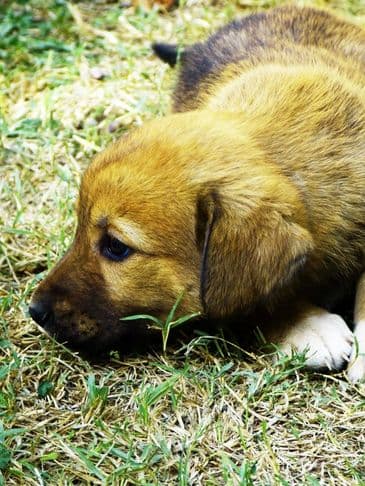
POLICE DOG PANDE None of the regular vendors on Platform No 6 at the Dadar railway station could remember when the brown and white mongrel had come to live in the station. He soon became a regular fixture there though, and rapidly acquired the essential skills he required to survive. The dog learnt to scurry away from the platform when local trains thundered into the station and disgorged a milling mass of humanity. The people on locals were always seemed to be in a tearing hurry, and the dog realized that not only did they not carry food scraps, but also they were impatient, and kicked aside anything or anyone that came in their way. But the long distance trains were another matter altogether. The dog knew when one was arriving because the turbaned coolies in the station would leap up eagerly and run to take up positions on the platform.
Then the dog would sit quietly on a corner of the platform too, smacking his lips in anticipation. The dog had discovered that travelers on long distance trains always carried oodles of food with them, and when they reached their destination would invariably discard the remnants. The dog feasted when a long distance train chugged into Dadar station, and during the rest of the time, he used his wits to find food. This was a difficult task, because none of the vendors who hawked food on the platform liked him. The biscuit vendor kept a stout stick tucked into his belt, and he waved it threateningly whenever the dog trotted behind his cart. The samosa vendor was even harsher - he hurled sharp stones at the dog whenever he saw him in the vicinity of his booth.
Even so, the dog sometimes outwitted them both, and ran away triumphantly with a hot samosa or a packet of biscuits that he had robbed when their heads were turned! The dog usually nosed in the dustbins on the station platform when the pangs of hunger gripped him, and though they usually contained some scraps of stale food, there were often times when he had to go hungry. The dog always tried to find a quiet comfortable place to sleep, away from the tooting trains and noisy crowds, but this was hard too. He had been beaten and chased away when he had tried to stretch himself out on one of the wooden benches in the second-class passengers waiting room. He could never creep under one of the iron benches that dotted the platform either, because travelers stuffed their boxes beneath them, and shooed him angrily away if he went near.
It was on a day when the dog was trotting along the platform looking for a place to catch forty winks that he spotted the room that served as the station's police chowky. Two stout police officers sat talking at a big table in the center of the cool, clean room. The dog stared interestedly at the inviting calm of the room, and then, inched towards it slowly and deliberately. When he reached the doorway, he put his head down and slunk silently into a corner of the room. Then he closed his eyes contentedly and drifted off to sleep. Later, when one of the police officers got up from his chair, he spotted the dog dozing in a corner of the room. "Hey! Who's this?" he exclaimed. The dog woke up with a start, and shrank back when he heard the policemen's loud voice.
"Oh it's only a harmless stray dog," said the other policeman who was rather kind. "I've noticed him running along the platform. Let him be." When the dog found that his presence was unchallenged, he came back to the police chowky the next day as well, crept into the corner again, and took a nap. The dog soon realized that he was onto a good thing, so he took care to be as quiet and unobtrusive as possible when he was inside the police chowky. He never barked or scratched himself, and he never got underfoot when the police officers were moving around. Soon they got quite used to the dog's presence, and when he began to wag his tail tentatively at them, they were not entirely displeased either.
They clicked their fingers at him sometimes when they had nothing to do, and sometimes even tossed a remnant chapatti his way after they had finished their lunch. The dog soon became bolder, and began to trot behind the policemen when they took rounds of the station. As he did so, he discovered that they commanded a lot of respect and fear, and it was to his advantage to be seen with them. The samosa vendor never shouted abuses and hurled stones at home when he was walking behind the police officers! And as the days went by, the dog intently observed the police at work. He watched carefully when they caught petty thieves and pickpockets and searched people's luggage, and he understood what they were about. And then one day, the dog was sitting on the platform waiting for a long distance train to steam in.
The platform was crowded with departing passengers as well, and as the dog cocked his ear and listened for the whistle of the arriving train, a loud shriek rang through the air. A pickpocket had dashed across the platform and snatched the handbag slung on the shoulder of a waiting lady passenger. And then, as she shrieked in horror, the thief sprinted across the platform and got away. "Catch him!" the lady shouted. The biscuit vendor began to give chase, but the thief was already way ahead, and he soon stopped. "Oh no!" the lady wailed. "My purse with all my money is in that bag! I'll never see it again!" "Look!" cried the samosa vendor suddenly, pointing excitedly. The dog had leapt up from his place and was bounding across the platform in pursuit of the thief.
His paws fairly flew over the ground, and as the samosa vendor screamed out in ncouragement, the lithe, strong dog gained on the thief. The thief, sensing danger, looked back for a second, and as he saw the open mouthed dog charging after him, he tried desperately to accelerate. But it was too late. The dog leapt on him with a snarl, and brought him crashing down. The stolen handbag flew out of his hand, and as shocked onlookers grabbed it, the dog stood over the terrified thief, his teeth bared in a snarl. The police, led by excited the samosa vendor arrived on the scene a few minutes later. As the thief was dragged away, the samosa vendor patted the dog tentatively. "You're a good dog," he said. "There's a fresh, hot samosa today!" As the dog dozed in the police chowky later, the police officers looked at him respectfully.
"I think we should adopt this dog and make him an honorary member of our force," one officer said to the other. "He has shown us today what good work he is capable of." "I agree," his colleague replied. "We'll get him a collar and license, and make sure that he has regular meals everyday." "But what shall we call him? "The first police officer asked, staring at the dog. "We can't just keep on calling him 'Aaye' like we do now..." "I once knew a brave and fearless policeman called Pande," the second officer replied, "perhaps we could call him that?" "Pande? It's sounds just perfect!" his friend agreed with a laugh. Then he clicked his fingers at the brown dog. "You are police dog Pande from now on, do you hear?" Police dog Pande wagged his tail in reply!
This story was published in the 'Young World' children's supplement of 'The Hindu' newspaper on March 10th, 2006. Please do not reproduce this story with permission.
Copyright Santhini Govindan. Please do not reproduce without permission.
Outwitting The Wind
A Quick Read
Outwitting The Wind
A Quick Read

OUTWITTING THE WIND 'Tap! Tap! Tap!' Kalia the crow jabbed his beak furiously into a branch of a large mango tree. Then he leapt up and down, cawed loudly, and began to jab the branch again. "Dear me," exclaimed Sonu squirrel who was passing that way, "What are you up to Kalia?" "I'm angry," Kalia retorted. "My nest has been destroyed once again! Do you know how hard I've been working these past few days with my dear wife to build a fine nest to raise a family?" "Yes, I did notice that you've been hard at work," Sonu replied sympathetically. "But all that hard work has been of no use at all," Kalia cawed angrily, "The wind came by this way twice and carried away all the twigs that we had gathered.
He is such a nasty fellow, and I'm going to find him, and punish him for what he's done to me!" Then Kalia put his head to one side and asked Sonu, "Do you happen to know where I can find the wind?" "Oh no", replied Sonu. He scampered away, and Kalia began to drive his beak into the mango tree once more. Then, as he jabbed away furiously, the mango tree's leaves rustled gently and she spoke. "Why are you doing that Kalia? That hurts me, you know!" "Oh," said Kalia, looking up in surprise. Then he drew himself up, and said, "I'm sharpening my beak you know. When it is as sharp as a sword, I'm going to go in search of the wild wind, and I'll peck him ever so hard with my beak. He has ruined all the hard work I put in to make a nest, and I must teach him a lesson!" The mango tree sighed - a long sad sigh.
When Kalia heard the sigh, he said to the tree in a tone of remorse, "I didn't mean to hurt you, you know. You have been very kind, and have given me shelter from the sun and rain. But you are so tall and strong, and you can't know how frustrating it is for a small crow like me when the powerful wind just blows away my nest!" The mango tree bent her great green head, and answered the crow softly. "I was not always tall and strong, you know, Kalia. At the beginning of my life, I was just a very small sapling. I was barely a foot tall when my first green leaves appeared. I was so proud of those tiny, tender leaves, Kalia. But a cow came along and ate them all up soon after they appeared. How disappointed I was, and how I wept after that, Kalia!
But after a while, I decided that I wanted to grow into a big tree after all, and I grew some more leaves..." "Oh," said Kalia impatiently, "but you grew big and strong after that didn't you? You only lost a few leaves. That's nothing compared to the fact that I've lost the precious home that my dear wife and I built all by ourselves twice over!" "You haven't heard the rest of my story," the mango tree continued calmly. "When I was just about two feet tall, the howling wind brought a storm my way one night, and he nearly pulled me out of the ground by my roots! The wind twisted and broke all my small branches too. I was really badly hurt that night, Kalia, and it took a long time for me to feel better again. But I was so eager to grow up and become a big mango tree that I was determined not to let the cruel wind take away my dreams.
So I held up my head again proudly even though it was bent and broken, and drank in the warm sunlight. The wind didn't give up bullying me, of course. He came along often, just to tease me, and he tried to push me around, but I just sank my roots into the ground deeper and deeper and clutched the earth as firmly as I could. And finally, one day, I was so big and strong that the mighty wind could not push me over with his might anymore. Nowadays, the wind just whistles when he passes me by, and sometimes, he snatches a few mangoes from me when my branches are laden with fruits," the mango tree added in quiet satisfaction. "You'll never be able to find the wind, let alone peck him with your beak, Kalia," the mango tree continued wisely.
"But if you really want to beat the wind, the best thing that you can do is build your nest all over again in a safe place on my branches where the wind will not be able to reach it. If you trust me, I'll show you the perfect spot! I'll help you because I wouldn't mind taking the proud wind down a notch or two either!" "Is there really a spot on your branches that the wind cannot reach?" Kalia asked doubtfully. "Yes indeed," the mango tree replied, rustling her leaves excitedly. Speaking in a whisper, she showed Kalia a cosy spot deep in the heart of her thick green canopy of leaves where many of her thick branches met. "The wind will never be able to reach this place with his long, probing fingers," she said. Soon Kala and his wife set to work, flying hither and thither to collect twigs, and build their nest.
Finally it was ready - an untidy little round nest nestled in the fork of some branches, deep in the heart of the mango tree. Soon after the two crows moved into their new home, the wind came along. As he swished over the mango tree in his usual imperious way in a great gust, the wind paused to see if there was anything that he could blow off from the mango tree's branches with a puff. Kalia and his wife trembled as they heard him whistle and blow over the mango tree's head. They huddled together anxiously in their nest. But the mango tree whispered softly, "don't worry my friends! You're quite safe now! With me on your side, the wind can't take away your home. He'll go away soon, you'll see." And as the disappointed wind wandered away after a few minutes, the mango tree began to chuckle!
Copyright Santhini Govindan. Please do not reproduce without permission.